Search This Blog

Wednesday, October 10, 2012

Getting to Know Your Reading Self

I believe Lucy Calkins calls it, "Building a Reader's Life."  In either case, we also spent the month of September getting to know our reading selves!  I can't stress how important it is that children be given the chance to learn about themselves as readers.  Consider this:  when was the last time you were asked what books you like to read and the person asking really wanted to know?  Then...that same person asked you to set goals for yourself as a reader?!

This is just one of many questions I ask my students in September.  I also ask (Thanks to Amy Buckner):

  • What is your history as a reader?
  • What keeps you reading?
  • What I know to be true about reading...
  • Books I love!

We also set reading resolutions (A lesson I stole from the Units of Study), discussed how to read faster, stronger, and longer (again...Units of Study), plus learned and practiced the importance of working with our literature partners.

I am excited about the possibilities this year will continue to offer for my students.  I am choosing to embrace the Common Core standards as a way to deepen my instruction and to make my instruction more valuable!

As we worked through this first month we read the following books:


(I'm probably missing one or two..)

We are now reading the following chapter book by the awesome Montessori-trained Lee Wardlaw: 101 Ways to Bug Your Parents.  The lessons we have pulled from this book have been useful for both reader's and writer's workshop.

People have asked, what program do you use for your reader's workshop?  I don't use any one program.  I jumped into Reader's Workshop before it was the "in" thing in my district.  I read Amy Buckner and Frank Serafini in the summer.  I had just finished reading and using the Writing Workshop Units of Study.  I figured that I could do this for reading!  My RW is my own creation.  It is not a curriculum or a program, rather my RW is a framework for instruction.  I use my student's needs to select lessons and guide student learning.  That's how I, "get it done!"

The Genre of a Test


The month of September was a busy one!  In our Reader's Workshop we focused on two main areas--a quick review of the genre of a test, and getting to know ourselves as readers.

Frank Serafini states the following, "When students are familiar with the tasks required by the tests, they are better able to focus their attention and energy on the content of the test and to demonstrate their abilities."  He continues to point out in his short article that the skills needed for a standardized test may be different than the skills supported in the reader’s (and writer’s) workshop.  Think about it, when do you give children a question and ask them to pick the least likely answer or the most likely answer?  Most of the time we are having deep discussions and conversations about text-what we agree or disagree with in the story or article, symbolism, inferring and synthesizing information, and among other things, making connections between stories, articles, and the media.

I agree that we must show that a test has value if our students are to take it seriously.  On my end, we do discuss in our workshop unit all the ways that tests can be useful and brainstorm ways that the test helps my teaching. Between you, the Internet, and me it’s not the test that’s the problem it’s the crazy directions (Really, no water bottles on tables for 4th graders testing for 80 and 60 minutes??) and the way the tests are used.  (Home real estate values, teacher evaluations..)

My unit, the genre of a test, includes the following lessons:
  • Test vocabulary and language
  • How tests are set-up
  • What we know about tests
  • Test reading tips (Using deductive reasoning to evaluate answers)
  • Using the QAR strategy (which becomes a BIG strategy for the whole school year!)

Frank Serafini calls this demystifying the test—it’s an excellent description.  I am teaching the kids it’s just another unit of study!  This year I added one additional element to my mini-lesson, which was to make a connection from the daily mini-lesson to our study of non-fiction.  For example, we do and will use the QAR method quite a bit when we are reading non-fiction.

To read more of Frank Serafini’s short article on the genre of a standardized test go to the following link:  http://www.frankserafini.com/PubArticles/ShortArticles/StTestsGenre.htm

Happy Reading!

Mrs. Perrien

Sunday, September 23, 2012

Running Records revisited...


I'm bumping this from Fall 2011:

I've had a few questions about when I complete my running records.  Simply put, I do them during my workshop conferring time.  My district requires a running record score on all students in the fall and again in the spring.  For my 4th graders this means I need to complete running records by the end of September. (I usually have scores on my 5th graders form the spring; many of them have tested out of the Rigby Running Record scale).

If I complete two running records each conferring session I'm able to have these completed by the September 30th deadline.  If I feel further assessment is needed, I will complete an authentic running record (using a book of the student's choice), an Informal Reading Inventory (My favorite is the Bader Reading and Language Inventory), and usually I will use the QRI site word assessment to get a balanced view of the reader.  I have found the QRI assessments to be useful when my students are reading past Rigby's level 30.

I personally feel that a running record on a 4th or 5th proficient reader to largely be a waste of time.  At that point it's time to move to an IRI or QRI inventory for a useful, authentic assessment.

************************
Fall 2012 Comments

I used the QRI assessment inventory to get a clearer picture of all my readers last spring.  What a difference!  Rather than stating that the student was an above average reader, I was able to more clearly articulate what I noticed in my readers and give them directions for next steps.  I highly recommend using an IRI model to assess your upper grade readers!

Conference deadlines

Conference deadlines are tricky!  Yikes!!  I had planned to submit a proposal to the Michigan Reading Association about presenting once again on Reader's Workshop, but this time focusing on "using materials you have."

Unfortunately, my memory failed me as I was thinking the proposal was due by Sept. 30.  I was off by several weeks and I should have submitted my proposal in early September.

So...a moment of sadness ensued...

Then I realized that I have others to consider!  I've decided to look into the American Montessori Society and write a proposal regarding reading workshop in a Montessori classroom.  After all, this is what I do every day.  I teach in a Montessori classroom.  I use the reading workshop method.

Whatever happens, I will continue to research and refine my study and use of the Reading Workshop method.

Reading Workshop.2012

I've hit the ground running this year in my reading workshop.  We've been so busy!  I'm copying a few comments from a post I wrote a year ago because some of my lessons these past three weeks have been the same.

Here's what I said last year about these early days:
***************************************


In the state of Michigan students take the MEAP test in October.  We have only a few weeks (approximately 3-4) to remind kids of all the great skills, strategies, and knowledge they learned in the previous school year.  Since I am not a policy maker I have no control over the testing date.  For what it's worth, it makes absolutely no sense to me whatsoever to have kids take the summer off, and then take a test in the fall when they are first back to school.  The test should be at the end of the school year!  At the end of the third grade year, take the third grade MEAP.

But since I am not in educational policy we are taking the MEAP in October.  So that's it then.

This year we are once again doing a reading workshop unit, "the First Ten Days," from the Oakland Writing Project, Eastern Michigan Writing Project, National Writing Projects of Michigan, and the Oakland Intermediate School District.  I really like this unit!  In these first ten days the students study the GENRE of tests--what they look like, sound like, etc.   They look at test language, practice writing test questions, and get to know the test from a practitioner level.  It's very empowering to the students to take apart the test and learn about its construction.

Here's a sampling of the work we did this week:

Doesn't it make sense to study what tests look like?  Yes, it does!!


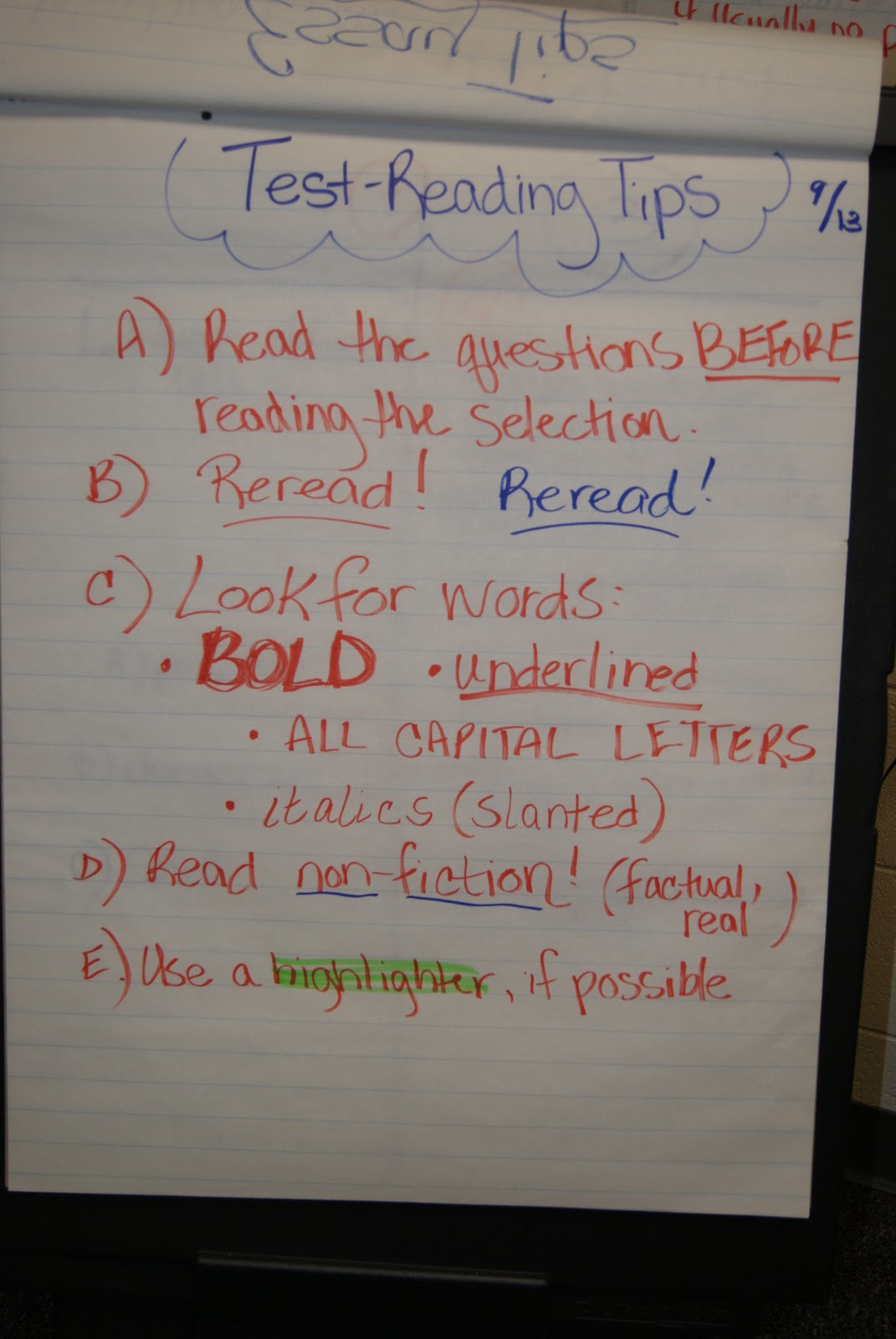
After we talk about what tests look like we talk about how to make them easier to take.  This is only one of our test reading tips posters.

Finally, we look at reading strategies that are useful with all tests.  Here's one we talked about on Thursday and Friday:


The QAR  strategy is one we refer to all school year!  When we looked at MEAP release items from years past we discovered that most of the MEAP questions were either "author and me" questions or "on my own" questions.  That tells us that the MEAP requires us to do more than just read the question and find the answer.
***************************************
Finally, this year (Fall 2012) we spent a great deal of time on the QAR strategy.  Students read lots of QAR questions and then tried their hand at writing their own using our National Geographic Explorer magazines. I've been incredibly impressed by the work my students have been doing this year in working with informational text.  It's not about the test, it's about informational TEXT, as this type of text is what students will encounter for most of their educational career, and professional life.

Friday, August 24, 2012

The Grand Plan...

I've laid out my plan for my reader's workshop.  Remembering that it is just that, a plan, I share it here.  I'm excited for my workshops to begin!


My Reader's Workshop Plan:

September

  • Establish workshop routines
  • Learn the genre of a test
  • Getting to know oneself as a reader

October

  • Launching the Reader's Workshop (continuation from September)
  • Moving into Strategies

November

  • Reading Fiction--focus on strategies
    • Visualizing, Schema, Questioning

December

  • Reading Nonfiction

January

  • Reading nonfiction

February

  • Reading Fiction--focus on strategies
    • Metacognition, inferring, and synthesizing

March

  • Reading Fiction
    • Literary Elements
    • Literary Appreciation

April

  • Reading poetry

May

  • Genre Study
  • Author Study
**This is a pretty basic structure.  I hope to write more at the beginning of each month as I lay out the month's lessons.  Finally, I am a Montessori teacher.  That means that I will adjust the plan when needed to meet the needs of my students.  That's just good teaching...really!  One final thought, each month's work should build upon the last.

Happy Reading!

--Mrs. Perrien

Monday, August 20, 2012

Back-to-School Resolutions!

Resolution setting is not necessarily my thing, as I have trouble keeping them!  However, I stumbled onto this Back-to-School Resolutions LINKY PARTY (Hosted by Teaching Maddeness) and decided to join in the fun!  I'm more likely to keep these resolutions because I'm making them public on my blog.  

Here are my Back-to-School Resolutions!


1:  My first resolution is to keep the paper trail under control in my classroom.  I'm resolve to PREVENT piles from forming by filing things immediately and using electronic filing whenever possible!

2:  I resolve to keep myself from overcommitting!  I am a full-time teacher, wife, and mother.  I need to keep my focus on my family and my work and say NO when something would take away from my kids, my husband, and my students.

3:  Remodel my master bathroom!  I know this isn't a back-to-school resolution, but it's something that needs to get done and we need to do it this year!

4:  I resolve to keep the focus on work when I'm at work!  It's easy to get roped into hallway conversations and lounge gossip.  While at work I need to be working and keep the focus on my students and their needs.

5:  Finally, I resolve to blog each week about my reading workshop!  :)

That's it!  Do you have resolutions to share?  Comment on this post or link to your own classroom blog.

Happy Reading!