Search This Blog

Monday, October 3, 2011

Books That Inspire Me

It's relatively easy for me to write about books!  I love to read.  I will give up sleep, a clean house, and clean clothes in order to read.  My family doesn't always appreciate my devotion to books, but that's okay!  At least one of my kids is an avid reader as well.

When I think of Reader's Workshop books, I immediately think of Aimee Buckner's book, Notebook Connections.  This is the book that got me thinking about changing my reading instruction to a reader's workshop.  Buckner's book isn't the only book that I've read; I want to share a few others.

Tanny McGregor's Comprehension Connections book is wonderful!  I resisted reading her book all school year last year because I was rereading Strategies That Work and Notebook Connections.  Thanks to a great deal of prodding by my friend, Kathy (a spec. ed. teacher at my school) I picked up Comprehension Connections over the summer and had a hard time putting it down.  I made notes, highlighted sections, and found mini-lessons throughout her book.  Now I'm reading the 2nd edition of Mosaic of Thought.  I found the first edition of the book to be insightful; but now that I'm older and, I dare say, *wiser,* the book has a new meaning for me.  I was especially appreciative of the sections that dealt with "Deep Structure" teaching and found myself marking areas to reread and use when I am deeper into strategy lessons this school year.  I say this every year, but I want to improve my conferring with students.  I believe that Mosaic of Thought will help me do just that!  I highly recommend the book and especially chapter 3.

If I could I would REQUIRE all new elementary teachers to read these books within their first year of teaching, form a book study group, and challenge each other monthly as teachers and scholars.  The books are that good, and will affect teaching that much!

...AND WHERE DO YOU KEEP THOSE BOOKS?

My home office is too small and is the only reason I've given any thought to moving in the past few months.  What will probably happen instead...is that I'll be adding shelves! (God Bless, Ikea!) I've become a lending library of sorts when friends are in graduate school.  If it's a book about reading and literacy I probably have it on my shelves!  My children's books are taking over our basement and my professional books are in my office, on my bedroom table, in the living room, at work, in the car...

IN THE CLASSROOM

In the past week we covered a lot of ground regarding fantasy and characters.  Two very different ideas in reading, but equally important.  First, we did discuss fantasy and our reading of the genre.  Next, we discussed characters--specifically how we describe characters.  Are they honest or greedy, friendly or selfish, generous or evil?  We learned how to find proof for our character analysis and also how to record this information in our reader's journal.


As students study characters this month they will develop a character project.  Students will choose one character from the book and analyze that character's traits.  They have the choice of three projects--create a trait poster, write a report, or dress and act as that character!  Students have a choice in their project, as long as they share their learning about the book and its characters.

One final comment:  We have started our first chapter book read aloud. (Prior to this we were reading short chapter books or picture books.)  We are reading, 101 Ways to Bug Your Friends and Enemies by Lee Wardlaw!  Our class will be using this book as our main mentor text for the next few weeks of reader's workshop.  Of course, we will read other books and study other authors but this books will be our read aloud as well as our mentor text.  It's "exciting stuff!"

Sunday, September 25, 2011

Running Records

I've had a few questions about when I complete my running records.  Simply put, I do them during my workshop conferring time.  My district requires a running record score on all students in the fall and again in the spring.  For my 4th graders this means I need to complete running records by the end of September. (I usually have scores on my 5th graders form the spring; many of them have tested out of the Rigby Running Record scale).

If I complete two running records each conferring session I'm able to have these completed by the September 30th deadline.  If I feel further assessment is needed, I will complete an authentic running record (using a book of the student's choice), an Informal Reading Inventory (My favorite is the Bader Reading and Language Inventory), and usually I will use the QRI site word assessment to get a balanced view of the reader.  I have found the QRI assessments to be useful when my students are reading past Rigby's level 30.

I personally feel that a running record on a 4th or 5th proficient reader to largely be a waste of time.  At that point it's time to move to an IRI or QRI inventory for a useful, authentic assessment.

What Keeps Me Reading?

This week our reading workshop switched gears.  While we wrapped our discussion of the testing genre we also made the switch to exploring our background as a reader.  It helps us move forward if we know where we started!

Wrapping up the testing genre including taking a turn at answering a constructed response question.  These can be tricky!  We discussed what the authors were looking for if they designed a constructed response question, how to find the answer (look BACK in the text), and how to write OUR answer to what is actually a multi-step problem.  These were grade on a scale of 1-4 and returned to the students for further in-class discussion.

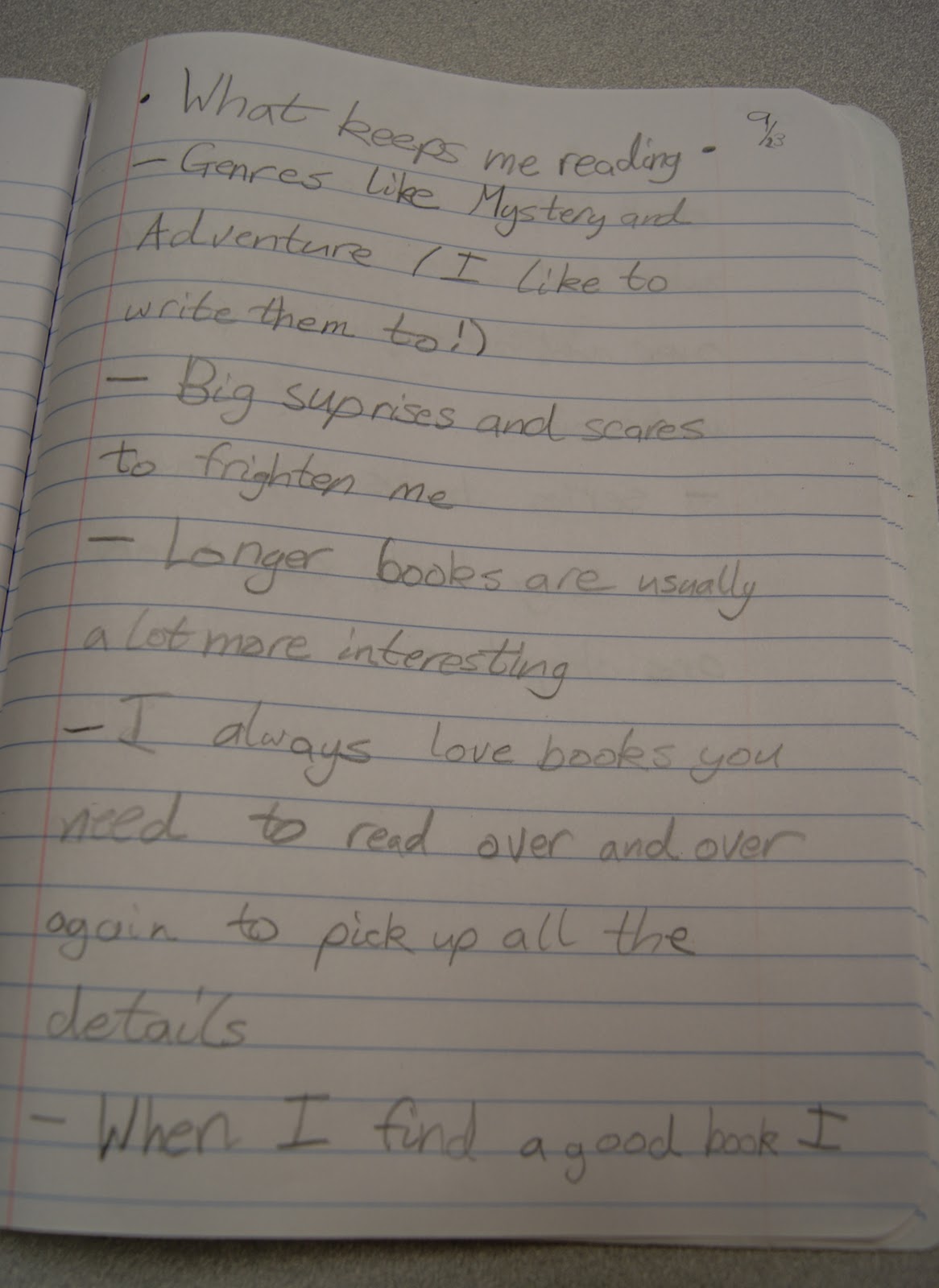
Next, we started to explore our background as readers.  Our Friday lesson was based on Aimee Buckner's lesson in Notebook Connections, "What Keeps Me Reading."  The chart we created in class started with Mrs. Perrien sharing what keeps her reading: 
Mrs. Perrien's answers are recorded in green.  Once the mini-lesson was complete the students took their reader's workshop notebooks and wrote for a few minutes about what keeps THEM reading.  When we concluded our workshop session via sharing we added students' ideas to the chart.  Their answers are recorded in orange.

To wrap up this week's post, I've added a few photos of Reader's Workshop entries from Friday:


Sunday, September 18, 2011

Another Reading Workshop Perspective

Another Waukazoo teacher and friend, Sarah Parker wrote a blog posting about her experiences with reading instruction.  She is an amazing teacher, instructing students in the primary grades.

http://learningontheedge.blogspot.com/2011/09/reading-workshop-2011.html

Reading Workshop--Week Two

In the state of Michigan students take the MEAP test in October.  We have only a few weeks (approximately 3-4) to remind kids of all the great skills, strategies, and knowledge they learned in the previous school year.  Since I am not a policy maker I have no control over the testing date.  For what it's worth, it makes absolutely no sense to me whatsoever to have kids take the summer off, and then take a test in the fall when they are first back to school.  The test should be at the end of the school year!  At the end of the third grade year, take the third grade MEAP.

But since I am not in educational policy we are taking the MEAP in October.  So that's it then.

This year we are once again doing a reading workshop unit, "the First Ten Days," from the Oakland Writing Project, Eastern Michigan Writing Project, National Writing Projects of Michigan, and the Oakland Intermediate School District.  I really like this unit!  In these first ten days the students study the GENRE of tests--what they look like, sound like, etc.   They look at test language, practice writing test questions, and get to know the test from a practitioner level.  It's very empowering to the students to take apart the test and learn about its construction.

Here's a sampling of the work we did this week:

Doesn't it make sense to study what tests look like?  Yes, it does!!


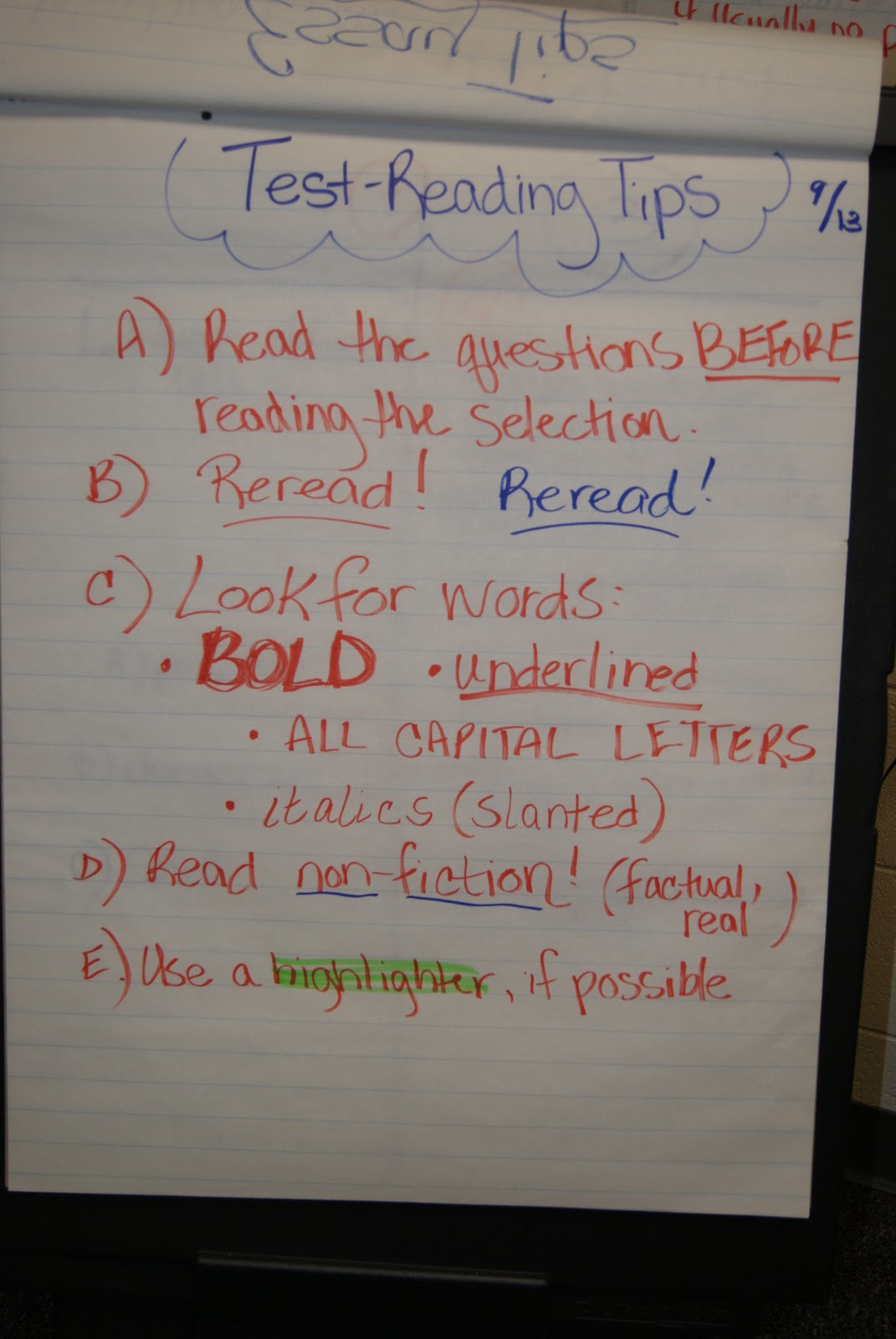
After we talk about what tests look like we talk about how to make them easier to take.  This is only one of our test reading tips posters.

Finally, we look at reading strategies that are useful with all tests.  Here's one we talked about on Thursday and Friday:


The QAR  strategy is one we refer to all school year!  When we looked at MEAP release items from years past we discovered that most of the MEAP questions were either "author and me" questions or "on my own" questions.  That tells us that the MEAP requires us to do more than just read the question and find the answer.

We will continue to study the genre of tests for our week three of reader's workshop.  However, we have also decided on our second genre study.  We will be studying fantasy.  All students must have a fantasy book in their hands (at least 100 pages) by Wednesday.  This genre unit will be fun!

Sunday, September 11, 2011

The First Week

Typically the first week of a Reader's Workshop in my classroom involves procedures...lots and lots of procedures!

Procedures Menu:

1.  Sharpening your Pencil--Students find out that sharpening their pencil, constantly, takes away from the focus of the reader's workshop.  Therefore, I restrict pencil sharpening (of any kind) to the very beginning of the workshop period.  Really, that's why I have a drawer full of sharp pencils!

2.  I let students read any book for the first two or three weeks of school.  It allows me to find out what kind of books students will typically pick when left on their own.  Are they reading comic books?  Are they jumping into a great novel?  Are they "pretending" to read?  It's a great time to begin my anecdotal records!

3.  Where do we sit during reader's workshop?  Anywhere...as long as it's not near your friend that will be a distraction to you or get you into trouble.

4.  We have to take notes???  Yes!  Notes are often related to the anchor charts we create in class.  Sometimes students are asked to "have a go" at the class anchor chart and create their own.

5.  You never know who's going to be turning in their reader's notebook, so do the work every day!  Expect to turn in your notebook at least two times during the week.

6.  Recess and lunch are times for talking with friends.  End of story.

7.  Yes, you really get to pick YOUR OWN BOOK for independent reading!

Those are the procedures we covered this week.  We also discussed a few important components of books and reading:

We read the following books as read-alouds this week:
The Teacher From the Black Lagoon.

My Many Colored Days by Dr. Seuss

Fireboat:  the Heroic Adventures of the John J. Harvey  **This book was our 9/11 read.  It's a wonderfully uplifting tale about a group of heroes on September 11.

Purpose

The task of this blog is to convey a year of reading workshop, as seen through the eyes of Amy Perrien and her 25 students at West Ottawa Montessori (WoMo) in Holland, Michigan.

Amy is a sometimes adjunct instructor at GVSU in the college of education--reading department.  She wants her reading students to see what takes place each week in her reading workshop and know that they can do it, too!

What's in 40?  Amy (or her students) will blog each week about the lessons, student work, successes, and failures of the reader's workshop.  She is figuring on 40 weeks for the school year.  In the end, you'll get a chance to see a year's worth of reading success stories, student work, teacher comments, and find out how Amy makes in work in a Montessori classroom.

Here's to real reading!