I don't admit this easily but when it comes to my students completing their weekly reading logs, I have failed as a teacher! No matter how I collect them, grade them, provide feedback, etc., SOMEONE forgets to fill out their reading log, someone changes a book without checking in first, and I continue to be frustrated. Of course, there is something in my teaching that isn't going right...and that's okay, because we all struggle somewhere!
Over break I read two things, Day-to-Day Assessment in the Reading Workshop by Franki Sibberson and Karen Szymusiak and the following blog, http://mrsrojasteaches.blogspot.com/. Both waxed poetic about the benefits of using State of the Class and made me a believer! When we return to school this week I plan to implement this idea. For now we're going to use this in place of the reading log until I reconsider how I want my log to look and what its purpose is in the classroom.
Rebecca Rojas has created a wonderful State of the Class document! You can see it here: http://mrsrojasteaches.blogspot.com/2011/10/few-of-my-favorite-things-about-this.html
Take a look at this idea if you're not already using State of the Class. I plan to update my blog after a few days and share my class results. I'll let the students post their thoughts as well!
Showing posts with label Assessment. Show all posts
Showing posts with label Assessment. Show all posts
Monday, January 2, 2012

Sunday, December 4, 2011
Genre Studies
Every other year my students do a year-long genre study project. It goes something like this:
I first revisit the State of Michigan GLCE for ELA to check up on the genres that 4th and 5th graders are supposed to be studying. This year I also checked out the Common Core document for ELA. According to the State of Michigan students in the 4th & 5th grade should be studying the following:
We begin by putting all the genres in a big basket. At the beginning of every month a volunteer student draws out the month's focus. So far this year we've studied mystery, fantasy, and now tall tales. At the same time I teach the students story grammar concepts (setting, characterization, plot, conflict, etc.) during reader's workshop. For this I have been studying the Common Core documents quite a bit, plus I continue to use the state GLCE's for narrative text structure:
When the 5th graders and 4th graders made a mystery mobile they each had different assignments. 4th graders had recently studied the story grammar structure so their mobile included characters (main and secondary) analyzed for their traits, setting, problem/solution, and theme. On the other hand, the 5th graders had a completely different set of expectations. Last year they had studied all that and more. Therefore, their mobile included an analysis of characters and a description of setting. Next, they created a story mountain which detailed the climax of the story. They had to identify the four types of conflict within the story (character vs. character, character vs. self, character vs. society, character vs. nature), and give two examples of figurative language found in the story. There may have been more but I've forgotten!
When we do an assignment such as read a mystery and create a mobile the students are given a reading schedule. First, they are told they must have the appropriate genre story by a certain date (usually 2-3 days are given to settle on a book). They sign up for their book and get to reading. I give them a finish the book date and remind them of this date every day in reader's workshop. By the time they finish the book they have post-it marked the book like crazy (Post-its mark examples that will be used to create the project.) and are anxious to begin. In this way we almost never have students with an overdue project. If students are late completing the project it's usually because they picked a book that was too hard, boring, too long, etc. This almost never happens because I catch this early using "state of the class" and reading conferences.
Projects could include creating a book poster, Powerpoint, Prezi, mobile, game, etc. For the month of December students will conduct a "thinkquest" at home assignment to go along with our study of tall tales.
These genre studies are fun and allow us to pack in a lot of work studying narrative text! For those wondering about nonfiction--this is a very big genre unit that typically lasts 8 weeks. We start it as soon as we return from our Christmas break. I'll talk more about that later! For those questioning my focus on genre studies and "making" students read genre that they don't like or have never read before, remember that they will not always have choice in their life. While in middle school or high school, they WILL have to read books/genre/authors that aren't their first choice. This exposure is incredibly important to building a well-rounded reader who thinks critically about the world. I'll close with an example from a former student, Will. He was NOT happy the month he had to read historical fiction. However, at the end of the month he admitted that he'd not only liked the book he'd chosen, he planned to check out another piece of historical fiction by the same author!
I first revisit the State of Michigan GLCE for ELA to check up on the genres that 4th and 5th graders are supposed to be studying. This year I also checked out the Common Core document for ELA. According to the State of Michigan students in the 4th & 5th grade should be studying the following:
- 4th: R.NT.04.02 identify and describe the structure, elements, and purpose of a variety of narrative genre including poetry, myths, legends, fantasy, and adventure.
- 5th: R.NT.05.02 analyze the structure, elements, style, and purpose of narrative genre
including historical fiction, tall tales, science fiction, fantasy, and mystery.
We begin by putting all the genres in a big basket. At the beginning of every month a volunteer student draws out the month's focus. So far this year we've studied mystery, fantasy, and now tall tales. At the same time I teach the students story grammar concepts (setting, characterization, plot, conflict, etc.) during reader's workshop. For this I have been studying the Common Core documents quite a bit, plus I continue to use the state GLCE's for narrative text structure:
- R.NT.05.03 analyze how characters’ traits and setting define plot, climax, the role of
- dialogue, and how problems are resolved.
- R.NT.05.04 explain how authors use literary devices including exaggeration and metaphors to develop characters, themes, plot, and functions of heroes, anti-heroes, and narrators.
- R.NT.04.03 analyze characters’ thoughts and motivation through dialogue, various
character roles, and functions including hero, anti-hero, or narrator; know first person
point of view and identify conflict and resolution.
When the 5th graders and 4th graders made a mystery mobile they each had different assignments. 4th graders had recently studied the story grammar structure so their mobile included characters (main and secondary) analyzed for their traits, setting, problem/solution, and theme. On the other hand, the 5th graders had a completely different set of expectations. Last year they had studied all that and more. Therefore, their mobile included an analysis of characters and a description of setting. Next, they created a story mountain which detailed the climax of the story. They had to identify the four types of conflict within the story (character vs. character, character vs. self, character vs. society, character vs. nature), and give two examples of figurative language found in the story. There may have been more but I've forgotten!
When we do an assignment such as read a mystery and create a mobile the students are given a reading schedule. First, they are told they must have the appropriate genre story by a certain date (usually 2-3 days are given to settle on a book). They sign up for their book and get to reading. I give them a finish the book date and remind them of this date every day in reader's workshop. By the time they finish the book they have post-it marked the book like crazy (Post-its mark examples that will be used to create the project.) and are anxious to begin. In this way we almost never have students with an overdue project. If students are late completing the project it's usually because they picked a book that was too hard, boring, too long, etc. This almost never happens because I catch this early using "state of the class" and reading conferences.
Projects could include creating a book poster, Powerpoint, Prezi, mobile, game, etc. For the month of December students will conduct a "thinkquest" at home assignment to go along with our study of tall tales.
These genre studies are fun and allow us to pack in a lot of work studying narrative text! For those wondering about nonfiction--this is a very big genre unit that typically lasts 8 weeks. We start it as soon as we return from our Christmas break. I'll talk more about that later! For those questioning my focus on genre studies and "making" students read genre that they don't like or have never read before, remember that they will not always have choice in their life. While in middle school or high school, they WILL have to read books/genre/authors that aren't their first choice. This exposure is incredibly important to building a well-rounded reader who thinks critically about the world. I'll close with an example from a former student, Will. He was NOT happy the month he had to read historical fiction. However, at the end of the month he admitted that he'd not only liked the book he'd chosen, he planned to check out another piece of historical fiction by the same author!
Sunday, September 25, 2011
Running Records
I've had a few questions about when I complete my running records. Simply put, I do them during my workshop conferring time. My district requires a running record score on all students in the fall and again in the spring. For my 4th graders this means I need to complete running records by the end of September. (I usually have scores on my 5th graders form the spring; many of them have tested out of the Rigby Running Record scale).
If I complete two running records each conferring session I'm able to have these completed by the September 30th deadline. If I feel further assessment is needed, I will complete an authentic running record (using a book of the student's choice), an Informal Reading Inventory (My favorite is the Bader Reading and Language Inventory), and usually I will use the QRI site word assessment to get a balanced view of the reader. I have found the QRI assessments to be useful when my students are reading past Rigby's level 30.
I personally feel that a running record on a 4th or 5th proficient reader to largely be a waste of time. At that point it's time to move to an IRI or QRI inventory for a useful, authentic assessment.
If I complete two running records each conferring session I'm able to have these completed by the September 30th deadline. If I feel further assessment is needed, I will complete an authentic running record (using a book of the student's choice), an Informal Reading Inventory (My favorite is the Bader Reading and Language Inventory), and usually I will use the QRI site word assessment to get a balanced view of the reader. I have found the QRI assessments to be useful when my students are reading past Rigby's level 30.
I personally feel that a running record on a 4th or 5th proficient reader to largely be a waste of time. At that point it's time to move to an IRI or QRI inventory for a useful, authentic assessment.
Sunday, September 18, 2011
Reading Workshop--Week Two
In the state of Michigan students take the MEAP test in October. We have only a few weeks (approximately 3-4) to remind kids of all the great skills, strategies, and knowledge they learned in the previous school year. Since I am not a policy maker I have no control over the testing date. For what it's worth, it makes absolutely no sense to me whatsoever to have kids take the summer off, and then take a test in the fall when they are first back to school. The test should be at the end of the school year! At the end of the third grade year, take the third grade MEAP.
But since I am not in educational policy we are taking the MEAP in October. So that's it then.
This year we are once again doing a reading workshop unit, "the First Ten Days," from the Oakland Writing Project, Eastern Michigan Writing Project, National Writing Projects of Michigan, and the Oakland Intermediate School District. I really like this unit! In these first ten days the students study the GENRE of tests--what they look like, sound like, etc. They look at test language, practice writing test questions, and get to know the test from a practitioner level. It's very empowering to the students to take apart the test and learn about its construction.
Here's a sampling of the work we did this week:

Doesn't it make sense to study what tests look like? Yes, it does!!

After we talk about what tests look like we talk about how to make them easier to take. This is only one of our test reading tips posters.
Finally, we look at reading strategies that are useful with all tests. Here's one we talked about on Thursday and Friday:

The QAR strategy is one we refer to all school year! When we looked at MEAP release items from years past we discovered that most of the MEAP questions were either "author and me" questions or "on my own" questions. That tells us that the MEAP requires us to do more than just read the question and find the answer.
We will continue to study the genre of tests for our week three of reader's workshop. However, we have also decided on our second genre study. We will be studying fantasy. All students must have a fantasy book in their hands (at least 100 pages) by Wednesday. This genre unit will be fun!
But since I am not in educational policy we are taking the MEAP in October. So that's it then.
This year we are once again doing a reading workshop unit, "the First Ten Days," from the Oakland Writing Project, Eastern Michigan Writing Project, National Writing Projects of Michigan, and the Oakland Intermediate School District. I really like this unit! In these first ten days the students study the GENRE of tests--what they look like, sound like, etc. They look at test language, practice writing test questions, and get to know the test from a practitioner level. It's very empowering to the students to take apart the test and learn about its construction.
Here's a sampling of the work we did this week:

Doesn't it make sense to study what tests look like? Yes, it does!!
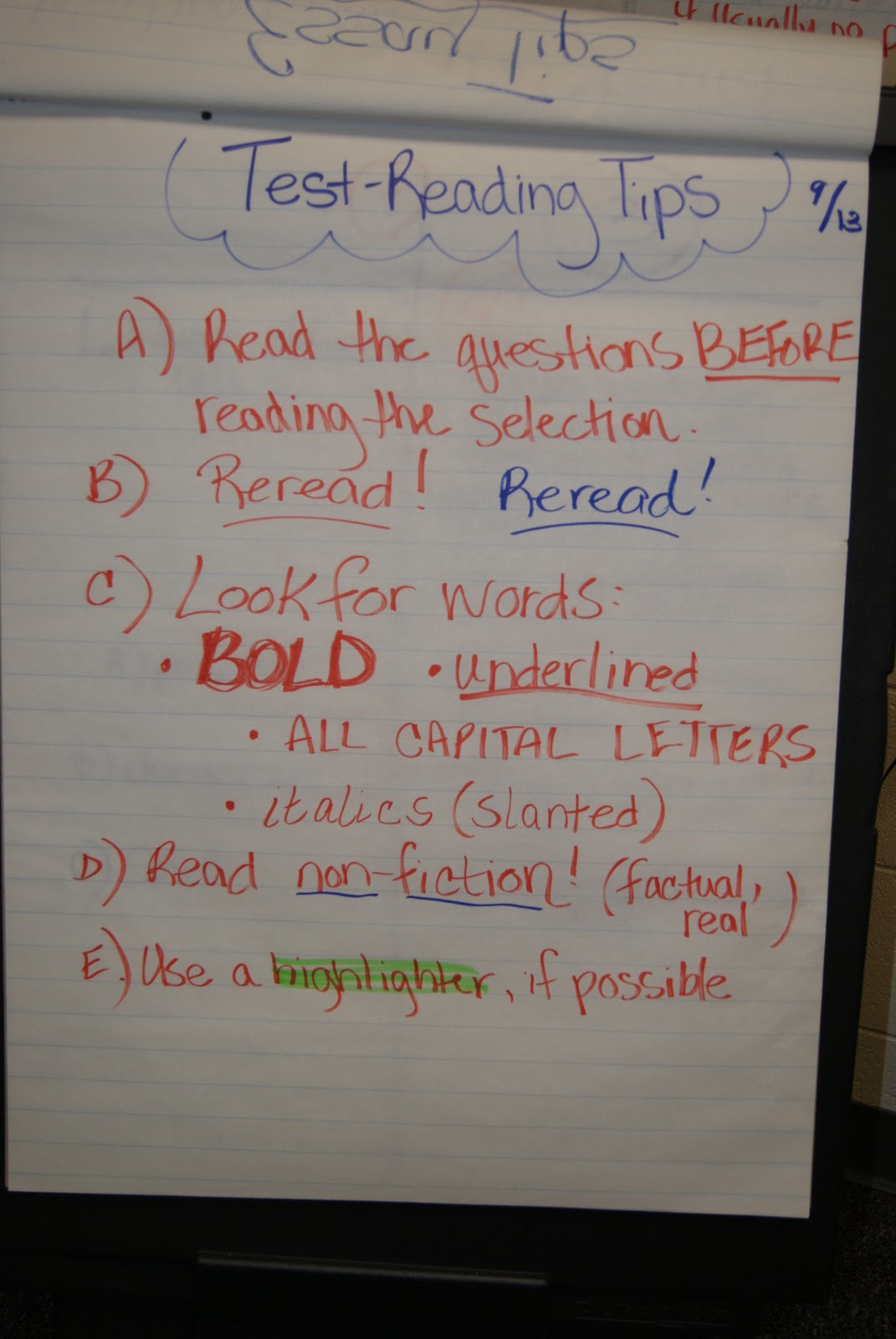
After we talk about what tests look like we talk about how to make them easier to take. This is only one of our test reading tips posters.
Finally, we look at reading strategies that are useful with all tests. Here's one we talked about on Thursday and Friday:

The QAR strategy is one we refer to all school year! When we looked at MEAP release items from years past we discovered that most of the MEAP questions were either "author and me" questions or "on my own" questions. That tells us that the MEAP requires us to do more than just read the question and find the answer.
We will continue to study the genre of tests for our week three of reader's workshop. However, we have also decided on our second genre study. We will be studying fantasy. All students must have a fantasy book in their hands (at least 100 pages) by Wednesday. This genre unit will be fun!
Subscribe to:
Posts (Atom)